My sumi-e is currently on dislay in France with other sumi-e artists from around the world. The exhibit is sponsored by the International Chinese Calligraphy and Ink Painting Society ~ ICCPS
For more information please see my post of August 8, 2012
Here is also a link to a very nice article about the exhibit from:
The exhibit runs from August 25 - September 2, 2012 The event is such a success the date has been extended to September 9, 2012!
Additional View of Exhibit
Bamboo Dancer
by Casey Shannon
This is my humble contribution to the exhibit. This contemporary vertical scroll is 12 x 30 inches and the image is 9 x 12 inches. Media: Sumi (ink) and Japanese watercolor on rice paper. This image was inspired by nature and the grace and strength of the bamboo.
For more of my contemporary Asian Scrolls please go to Gallery Shuen
In the largest oriental park in Europe, an international sumi-e and calligraphy exhibit will be held on the above dates. Twenty-one artists from 10 different countries will be participating in the prestigious event. I am honored to represent the United States in this exhibition of beautiful work.
The exhibit is sponsored by the ICCPS -
International Chinese Calligraphy and Ink Painting Society
Under the direction of the French Branch Director, Mr. Gregory Cortecero
Chinese artist Chang Dai-chien (also known as Zhang Daqian) may not have
the kind of name recognition that Pablo Picasso enjoys, but he is regarded as 'The Picasso of China' and the most important Chinese painter of the twentieth century.
Chang Dai-chien (simplified Chinese: 张大千; traditional Chinese: 張大千; pinyin: Zhāng Dàqiān; Wade–Giles: Chang Ta-chien) (May 10, 1899 – April 2, 1983) was one of the best-known and most prodigious Chineseartists of the twentieth century. Originally known as a guohua (traditionalist) painter, by the 1960s he was also renowned as a modern impressionist and expressionist painter. Chang was also known as a master forger of old master paintings. Art experts will agree, that in rare art collections around the world, Chang Dai-chien forgeries posing as other masters' creations are lurking in their midst unknown by the collections owners. Chang was that good!
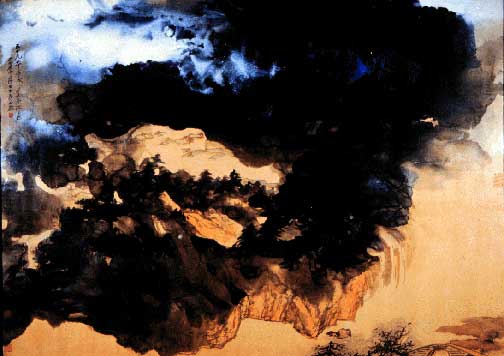
It is his paintings of the 1960's and 1970's that I am most drawn to. He lived on the California coast at that time in Carmel. I currently live in Carmel and am also inspired by the beauty of this area (Carmel, Pebble Beach, Big Sur, Carmel Valley). I see every day the landscape that so inspired him while he lived here. He painted the area in his unique technique. During this time, he unexpectedly developed his most innovative painting technique of splashed ink and color which serves as a source of inspiration to the ink painters of today including myself.
Clouded Mountains (painting above) exemplifies the splashed ink technique.
The poem, inscribed by Chang on the painting, reads:
I was in the mood to paint in the middle of night
My wife and son were awakened from their dreams
Ink overturned and running out of control
Emerging from the summer clouds a celestial mountain
Chang Dai-chien
Even though the artist lived half of his
career in the West and a decade in California, his work remains
virtually unknown in the American art world except in the Chinese
American community and among scholars. I recently stumbled across this amazing artist in my ink painting research. Because ink painting is segregated academically and rarely presented in American museums, there is a widespread
lack of familiarity about its traditions,
aesthetics and practitioners. Perhaps as few non-Chinese can read
inscriptions, rapid or casual appreciation is limited for many.
Versing the Landscape
This painting is one of my favorites of Chang Dai-chien's. It is a painting of the California coast and looks to me as if it is the Big Sur coastline with the fog hugging the coast and the Monterey pines. Chang especially loved painting the Monterey Pines found in Carmel and Big Sur.
The video below is a trailer of a movie about Chang that was developed by San Francisco State University in California. It contains shots of him with his beloved trees. Enjoy!
After establishing a major reputation in
China, Chang Dai-chien emigrated to the West after the Communist
Revolution in 1948. He traveled and exhibited extensively in Asia,
Europe and South and North America, living in garden home/studios in
both Brazil and California. He visited California as early as
1954/55, staying with a friend in Berkeley for a few days at a time
during international stopovers. In the mid-
1960s, Chang Dai-chien and his wife Hsu Wen-po began spending more time in California. The artist spent increasing percentages of time in California
throughout the remaining years of the Sixties. The artist professed his
move was inspired by the distinctive pines of the Monterey
peninsula, which reminded him of Chinese trees he
had painted earlier in his career, and which became signifiers of this
period and place in his painting.
Cloudy Waterfalls and Summer Mountains
The artist and his wife initially stayed for
months at a time at Thomas Chew's Dolores Lodge in Carmel, where
they occupied a special cabin with a suite of rooms. He bestowed the
name 'K'e-yi Chu' (translated as 'barely habitable' or 'just OK') on his
first Carmel house which was purchased in 1968, and the garden
pavilion at his second home which he purchased in 1971.
The second house was located on the exclusive Seventeen Mile Drive and
had a sandy yard large enough for him to develop a separate studio
and a garden. The transformation of the
sandy yard into an opulent garden became a daily preoccupation and
passion. Chang once lost his shoes in the mud after running into an
orchard to admire a tree, and caused consternation by asking if he could purchase and
transplant fully grown trees from neighbors explaining that he was too
old to wait for trees to
grow from seedlings. (From: Mark Johnson, Professor at SJSU)
Splashed Ink on Gold (Pebble Beach)
Debatably the richest and most dramatic
splashed ink paintings date from the years of 1967 to 1969, which
achieve the "forcefulness and immediacy" of the strongest Abstract
Expressionist painters. These landscapes sometimes incorporate rich
swaths of color including yellows and golds which were unprecedented
in the artist's earlier landscapes, possibly reflecting California color
and inspiration, although many of these pictures continue to rely
on the blue-green associated with ancient Chinese landscape painting.
Landscape 1967
Several landscapes painted during and after
1967 resemble California locations the cliffs of Big Sur and the
hills of the Coastal Range. In an interview published in May
1970, Chang
Dai-chien explained that he was "busily absorbing Carmel into his being
and hope(d) to soon be able to paint Carmel in the Chinese manner." Although far from photographic and often including only portions of
recognizable landscapes, the resemblance to California locations is an
important aspect of Chang Dai- chien's paintings after 1967.
Summer on California Mountain
Noted San Francisco art critic Alfred
Frankenstein reviewed Chang Dai-chien's art at a San Francisco exhibition, and wrote very positively about
the splashed ink works which seemed to him to be "both ancient and
modem at once ... original and decidedly up to date." Frankenstein
dismissed the artist's more traditional works, writing "one feels that
Chang Dai-chien came into his own only when he shook off the weight
of the ancient dynasties he had carried for so long on his shoulders."
Annual International Exhibition AnShan City, China
This
is the 2nd annual ICCPS International Exhibition in China.We
are pleased to announce the ICCPS exhibition at AnShan City, Liaoning province, China Dates:
2012 Oct 1st to Oct 10th.
This exhibition is supported by administration bureau of AnShan City,
Liao- ning province,
China Liaoning artist association and ICCPS
China Liaoning branch. Top artists’ in China will participate also.
North American Branch Participants:
1. Marc Bauer-Maison - Canada
2. Tai Oi Yee - Canada
3. Kalpa MacLachlan - Holland
4. Debra Self - USA
5. Nona Spitzer - USA
6. Casey Shannon - USA 7. Sonja de Jongh - Holland 8. Patricia Larkin Green - USA
You have decided that the meditation and grinding process before starting a sumi-e painting to center your mind is for you. OK, now you ask yourself, "What kind of ink stick should I use?" I have grappled with this issue and did some research to try and gain some knowledge on this subject. I pleased to share here with you what I found. Here are 5 kinds of ink stick.
The above color ink sticks are very beautiful. Chinese ink sticks have been used for thousands of years to create ink
for calligraphy and watercolor paintings.
This Chinese calligraphy ink stick set includes fifteen ink sticks. Each
one features an image of a Dragon. Significant since we are currently in the year of the dragon. These sticks may be used for writing
calligraphy or watercolor painting. To create ink using one of these ink
sticks simply add a little water to an ink stone and rub the ink stick
on the bottom until the desired amount of pigment is released.This adds bits of color to your composition and these are very fun to use.
Shanghai Premium Ink Stick
Sample
This ink stick is made from
coal oil creating a shiny brown-black finish that is smooth.
It's highly regarded as one of China's finest quality in ink
sticks. It has markings of "101" on the side of the stick to
differentiate it from others. Expensive at about $30 US
Oil Ink Stick
Sample
Made with coal oil, this ink comes close to the standards
set by the Shanghai Premium 101 Ink Stick, without the hefty price tag. Price is about $10 US
Yellow Mountain Pine Smoke Ink Stick
Sample
This ink stick is made from pine soot creating a matte
blue-black finish that is gritty in texture. Some artists use
this ink for bird feathers to show a subtle variance from
the intense line work of the beak and other outlines. Price is about $10 US for small stick and about $25 US for large stick.
Premium Blue-Black Ink Stick
Sample
This ink stick produces a matte, gritty texture blue-black tone finish ink. Expensive: about $30 US. This ink stick is my personal favorite. I can get rich deep tones and light soft grey tones using this ink stick. I also like the gritty texture it produces.
Whatever ink stick you decide to use, do not forget to find the right grinding stone or slate for you. These stones will enhance your experience so choose your stone carefully..
Collectors Slate "Plum Blossom"
This slate is a 'rare and one of a kind' grinding stone. Multi-colored mineral deposits each become fine plum blossoms on a grand and glorious plum tree, embracing the well.